Upgrading to a Daikin Fit System vs. Traditional Multi-Stage Heating for Puget Sound Winters
Trust Allred
The Pacific Northwest's damp winters demand more than a standard furnace. Discover how continuous inverter technology manages indoor moisture and heat differently than traditional systems.
The Myth of Universal Heating Solutions in the Pacific Northwest
There is a common misconception among homeowners that any modern furnace will keep your home equally comfortable during the winter. At Allred Heating Cooling Electric, our team frequently hears from customers who, when looking into Upgrading to a Daikin Fit System vs. Traditional Multi-Stage Heating for Puget Sound Winters, quickly realize that our regional climate demands much more than basic temperature control. The reality is that the specific weather patterns of the Pacific Northwest require specialized moisture and temperature management that standard systems simply cannot provide.
If you need immediate assistance with your home's climate control, explore our Air Conditioning and Heat Pump Services or book your system installation and replacement in Auburn today.
For years, the standard approach to a failing furnace was to swap it out for a newer version of the exact same technology. However, as heating engineering has advanced, our team has seen homeowners face a critical decision point: deciding whether to replace an aging system with a traditional multi-stage furnace or upgrade to Daikin Fit continuous inverter technology. Making the right choice before the deep cold sets in is crucial for your long-term comfort, your monthly energy efficiency, and your home's overall indoor air quality. A universal, one-size-fits-all approach to heating ignores the unique environmental factors right outside your door.
Why Damp Cold Changes the Heating Equation in Puget Sound
To understand why standard heating solutions often fall short in our area, you have to look at the physics of damp cold. Heavily emphasizing that Puget Sound winters are characterized by damp, penetrating cold and high humidity rather than extreme sub-zero temperatures is the key to unlocking true indoor comfort. In dry climates, a 40-degree day might just require a light sweater. In our years of servicing HVAC systems here in Auburn and the broader Puget Sound region, we know firsthand that 40 degrees can chill you right to the bone.
- Thermal conductivity of moisture: Water conducts heat away from the body much faster than dry air. When your home's indoor humidity is high, the air literally pulls body heat away from your skin, making you feel colder than the thermostat reading suggests.
- The clammy environment: Traditional heating systems often fail to address indoor humidity during the winter months, leaving the air feeling heavy, stale, and uncomfortably clammy even when the heat is running.
- Condensation on windows: High indoor humidity combined with cold outdoor temperatures leads to window condensation, which can eventually cause hidden moisture damage or encourage organic growth around sills and frames.
- The need for low and slow heating: To properly dehumidify the air while warming it, a heating system needs to run continuously at a lower capacity, drawing moisture out of the air over a longer period of time.
The Impact of Winter Humidity on Home Comfort
Moisture fundamentally alters your perceived temperature. When your indoor air is highly humid, you will likely find yourself constantly bumping up the thermostat just to feel warm. This creates a frustrating cycle of high energy usage without ever achieving true comfort. Furthermore, damp environments naturally lead to uneven heating and noticeable cold spots throughout the house. Because dense, moist air is harder to circulate evenly, rooms furthest from the furnace often remain chilly while the room with the thermostat becomes uncomfortably hot.
The Limitations of Traditional Multi-Stage Furnaces
Traditional multi-stage heating systems are certainly a step up from older single-stage models, but they still operate on a fundamentally limited framework. A multi-stage furnace typically operates on two or three fixed output levels—for example, running at 60% capacity for mild cold and kicking up to 100% capacity when the temperature drops significantly. While this provides some level of modulation, it still relies on a rigid, stepped approach to climate control.
The core problem with this technology in a damp climate is the blast-and-stop cycle. The system blasts hot air into the home until the thermostat is satisfied, and then it shuts off completely. During the time the system is off, the air stagnates, and the persistent regional humidity begins to creep back into your living spaces. By the time the system turns back on, you are already feeling a chill. These frequent on/off cycles fail to continuously remove moisture from the air, leading to that familiar clammy indoor feel.
Furthermore, the wear and tear associated with aging traditional furnaces often prompt emergency upgrades. Just last spring, our technicians responded to a local homeowner who experienced the downside of pushing an aging traditional furnace too far when their system quit working unexpectedly. Our team thoroughly checked the system and identified cracked heat exchangers—a dangerous issue that can cause carbon monoxide leaks. We ultimately installed a new furnace, which not only resolved the immediate safety hazard but also drastically improved the household's sinus and allergy problems. If you have ever wondered why your traditional gas furnace clicks but won't heat, our field experience shows it often traces back to the intense mechanical stress caused by years of these abrupt startup and shutdown sequences.
The Blast-and-Stop Cycle Explained
Every time a traditional multi-stage furnace kicks on, it requires a significant surge of electricity to start the blower motor and ignite the heating sequence. These inefficient energy spikes during startup add up over the course of a long winter. More importantly, the blast-and-stop cycle creates noticeable temperature swings between cycles. Your home might swing from 68 degrees to 72 degrees and back down again, forcing your body to constantly adjust to a changing environment rather than enjoying a steady, comfortable baseline.
How the Daikin Fit Adapts to the Cold with Inverter Technology
The solution to the blast-and-stop cycle is variable-speed inverter technology. Unlike a traditional system that only knows a few fixed speeds, the Daikin Fit continuous inverter technology modulates its capacity in tiny increments. Think of it like the accelerator pedal in your car: instead of slamming on the gas and then hitting the brakes, an inverter system gently applies just enough power to maintain your exact cruising speed. It can ramp up or down seamlessly to match the precise heating load required by your home at any given moment.
The primary benefit of this technology is the low and slow operational method. By running continuously at lower speeds, the system provides superior, consistent dehumidification. The indoor coil stays active longer, allowing it to constantly extract excess moisture from the air before circulating warm, dry, and comfortable air back into your living spaces.
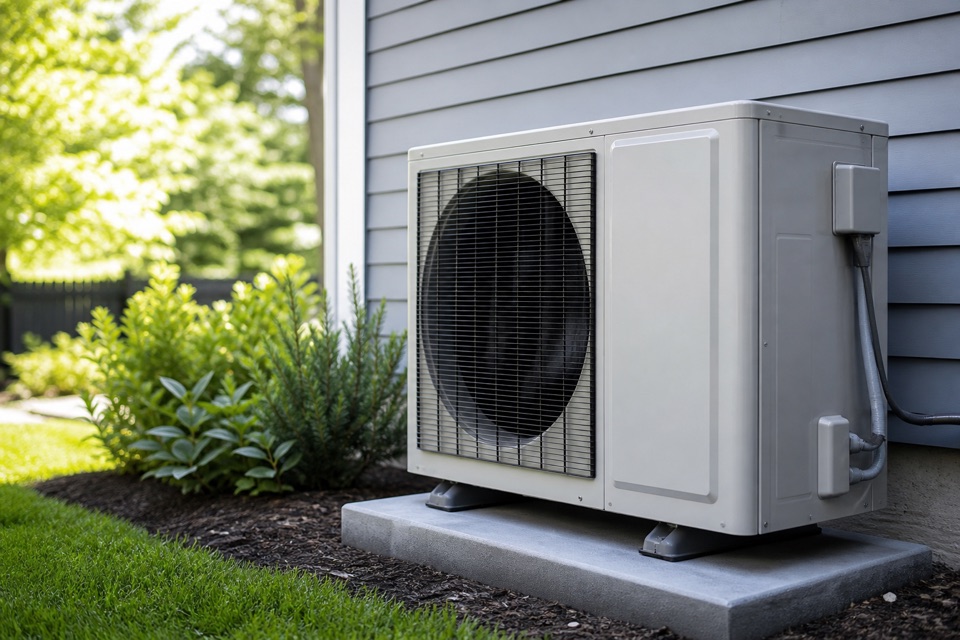
Beyond performance, the physical footprint of the Daikin Fit offers a massive advantage. Its compact, side-discharge design saves significant space compared to traditional bulky units, making it ideal for homes with limited lot lines or tight outdoor clearances. Additionally, because the system operates continuously at low speeds, it virtually eliminates the loud, disruptive kick-on noises associated with traditional furnaces. You simply get quiet, steady warmth.
Mastering Moisture Management
Continuous air circulation prevents air stagnation, which is the enemy of winter comfort in the Pacific Northwest. When the air is constantly moving and being filtered, you eliminate cold spots and maintain exceptional indoor air quality. Because the Daikin Fit lowers the overall indoor humidity, it allows for a lower thermostat setting while maintaining the exact same level of perceived comfort. You feel warmer at 68 degrees in a dry home than you do at 72 degrees in a damp one.
Head-to-Head: Comfort, Consistency, and Efficiency
When you place these two technologies side by side, the differences in daily operation become starkly apparent. While multi-stage systems have served homes well for decades, we find that the specific demands of Auburn and the broader Puget Sound region heavily favor the advanced engineering of inverter-driven heat pumps.
| Feature | Daikin Fit (Continuous Inverter) | Traditional Multi-Stage Heating |
|---|---|---|
| Temperature Control | Modulated precision; maintains exact thermostat setting. | Noticeable temperature swings between heating cycles. |
| Moisture Management | Continuous dehumidification via low-and-slow operation. | Intermittent drying; humidity rises when system is off. |
| Energy Consumption | Lower, steady energy draw; highly efficient cruising speed. | High-amperage startup spikes; rigid capacity stages. |
| Noise Levels | Ultra-quiet operation; no abrupt startup sounds. | Noticeable fan noise and mechanical clicks during startup. |
| Physical Footprint | Compact, side-discharge outdoor unit. | Traditional, bulky top-discharge cabinet. |
When evaluating the long-term value of your investment, energy consumption plays a massive role. The steady energy draw of the Daikin Fit significantly reduces the electrical strain on your home. Furthermore, general energy rebates, federal tax credits, and utility incentive programs often heavily favor high-efficiency inverter systems. While programs change frequently, homeowners who upgrade to top-tier variable-speed heat pumps frequently qualify for substantial incentives that help offset the initial installation costs. Always consult your utility provider or a tax professional to verify current eligibility.

Energy Efficiency and Pre-Winter Preparation
Timing your heating upgrade is just as important as selecting the right equipment. Waiting until the deep winter cold hits is the absolute wrong time to replace a failing system. When temperatures plummet, our HVAC contractors are booked out for weeks with emergency calls, and you may be forced to make a rushed decision just to restore heat to your home.
The October pre-winter heating startup season is the critical window for evaluating and upgrading your heating system before persistent dampness sets in. By taking action in the fall, you give yourself the time to properly research your options, secure financing if needed, and schedule a relaxed, thorough installation with our team.
- Schedule a comprehensive assessment: Have a professional evaluate your current system's performance, ductwork integrity, and overall lifespan before the cold arrives.
- Review your energy bills: Look for unexplained spikes in your winter heating costs from the previous year, which often indicate a system that is losing efficiency.
- Evaluate your indoor air quality: Take note of excessive dust, lingering odors, or a clammy feeling in the home, all of which point to poor moisture and air management.
- Plan for precise calibration: Understand that proper installation and calibration maximize the energy efficiency ratings (SEER/HSPF) of new equipment. A high-end system installed poorly will perform like a budget system.
Even if you decide to delay a full replacement for another season, keeping your current system optimized is essential for your safety and performance. Scheduling routine HVAC maintenance ensures that your multi-stage furnace is cleaned, inspected, and tuned to handle the upcoming winter workload as efficiently as possible.
Choosing the Right Upgrade Path for Your Home
Ultimately, while multi-stage furnaces are a definitive step up from older single-stage models, we find that they simply do not match the specific climate-handling capabilities of an inverter system. The continuous operation, superior dehumidification, and steady energy usage of the Daikin Fit make it the premier choice for combating the damp chill of Auburn and the broader Puget Sound region.
However, the equipment is only half of the equation. Maximizing the benefits of advanced technology requires precise, custom calibration to your home's unique ductwork, layout, and thermal envelope. If an inverter system is not properly matched to the static pressure of your ducts, it cannot deliver the whisper-quiet, ultra-efficient performance it was designed for. Choosing the right contractor is just as critical as choosing the right equipment.
In our experience serving the community, this is where local expertise makes all the difference. Allred Heating Cooling Electric has deep expertise in matching advanced inverter systems like the Daikin Fit to the unique demands of the Pacific Northwest climate. A professional assessment from our team can definitively determine the best system for your specific property, ensuring that your investment translates directly into unmatched winter comfort.
Frequently Asked Questions About Upgrading Your Heating System
How does a continuous inverter heat pump work in winter?
A continuous inverter heat pump works by extracting ambient heat from the outside air, even in cold temperatures, and transferring it inside your home. Instead of shutting on and off, it modulates its output constantly to match the exact heating demand of your living space. This results in a steady stream of warmth and highly efficient energy usage throughout the winter.
Is a Daikin Fit better than a 2-stage furnace?
Yes, for most homes in damp climates, a Daikin Fit continuous inverter technology system outperforms a 2-stage furnace. It provides much more precise temperature control by adjusting in tiny increments rather than just two fixed speeds. Additionally, its continuous operation offers superior humidity management, eliminating the clammy feeling often left behind by traditional furnaces.
What is the best heating system for Washington winters?
In our experience, the best heating system for Washington winters is one that prioritizes moisture removal alongside efficient heating. Because our region experiences damp cold rather than extreme dry freezing, we highly recommend variable-speed inverters. They run low and slow, pulling humidity out of the air while maintaining a consistent, comfortable temperature without massive energy spikes.
Will upgrading my heating system qualify for tax credits?
Federal tax credits and local utility rebates may apply to qualifying high-efficiency heat pumps, including many inverter-driven models. These incentives are designed to encourage homeowners to adopt greener, more efficient technologies. However, programs change frequently, so homeowners should always consult their utility provider or a tax professional for current eligibility and generic program requirements.
How long does it take to install a new Daikin Fit system?
A professional installation of a Daikin Fit system is typically completed in one to two days. The exact timeline depends heavily on the condition of your existing ductwork and your home's current electrical infrastructure. A thorough pre-installation assessment by our technicians will identify any necessary modifications, ensuring the actual installation day proceeds smoothly and efficiently.
Secure Your Winter Comfort with an Expert Installation
As the October pre-winter heating startup window begins to close, now is the time to finalize your home comfort strategy. Do not wait until the damp, bone-chilling cold takes over to realize your aging furnace can no longer keep up. Take control of your indoor environment by scheduling a comprehensive consultation and installation estimate with Allred Heating Cooling Electric today. Our local experts are ready to help you evaluate your home, compare your options, and secure a warm, dry, and highly efficient winter for your family.
Related Articles
Ready to Get Started?
Whether you need a repair, maintenance, or a new installation, our expert team is here to help.