What Does a Flashing Red Light on My Furnace Motherboard Mean?
Allred
A blinking red light on your furnace during a cold snap indicates a diagnostic lockout. Understand these flash codes so you can safely decide when to reset or call a pro.
Why Is There a Flashing Red Light on My Furnace Motherboard?
Is your house getting colder by the minute, and when you checked the utility closet, you found a blinking light staring back at you? If you are asking yourself, "what does a flashing red light on my furnace motherboard mean?" you are dealing with a built-in diagnostic feature, not a random malfunction. In our years of serving Auburn, Washington, we know that discovering a furnace issue during the late fall or November heating demand can be incredibly stressful, especially when indoor temperatures drop rapidly. Fortunately, that blinking light is actually trying to tell you exactly what went wrong.
Modern heating equipment relies on an internal control board to manage the entire heating cycle. When a safety sensor detects a problem, the system intentionally shuts down to protect your home from hazards like overheating or gas buildup. After three to five failed ignition attempts, the furnace enters a state called a "hard lockout." This means the system will not attempt to run again until the error is cleared or resolved. While some lockout codes require a simple, safe reset, others demand professional emergency repair services to restore your air conditioning and heating systems to full functionality.
The first thing to know: Do not panic. The red light means your system's safety protocols are working exactly as designed. The next step is simply understanding how to read the message it is sending without putting yourself at risk.
Safely Reading Your Furnace's LED Flash Sequence
Before taking any action, you need to observe the specific LED flash sequence. However, our technicians always advise that safety is the absolute priority. Homeowners should never open the main furnace panel to inspect the motherboard directly. The internal cabinet houses high-voltage wiring, sensitive circuit boards, and gas components. Removing the door can expose you to electrical shock and often triggers a door switch that cuts power to the furnace, erasing the very diagnostic code you are trying to read.
Instead, manufacturers provide a safe method for observation. Here is how our team recommends you safely read the code:
- Locate the sight glass: Look at the lower door of your furnace (the blower compartment). You will usually see a small, clear plastic window about the size of a quarter.
- Turn off the lights: If your utility room is bright, dim or turn off the room lights so the red LED is easier to see through the tinted glass.
- Observe the pattern: Watch the light carefully. Note whether it is a fast, continuous flash or a specific counted sequence.
- Count the flashes: Most modern sequences use a combination of short flashes and long flashes. For example, you might see three short flashes followed by two long flashes.
- Write it down: Document the exact sequence (e.g., "3 short, 2 long" or "continuous rapid blink"). This information is incredibly valuable when you call our team for repairs.
By keeping the door securely closed and observing through the sight glass, you keep yourself safe while gathering the exact data needed to troubleshoot the lockout.

Decoding Common Furnace Blinking Red Light Patterns
Furnace flash codes usually represent a two-digit number designed to point technicians toward the failing component. While every manufacturer has a specific diagnostic chart (often printed on the inside of the door panel), the types of faults that trigger a hard lockout are fairly universal.
One of the most frequent triggers our crew encounters is an ignition failure or flame sensor issue. The flame sensor is a thin metal rod that detects whether a fire has successfully ignited. If it gets dirty, it cannot sense the flame, and the motherboard shuts the gas valve off immediately. In our experience working across Auburn, the cold, damp humidity in late fall can accelerate oxidation on these flame sensors, making this a highly common reason for a blinking red light.
Another common fault involves the limit switch. This safety device monitors the internal temperature of the heat exchanger. If the furnace overheats—often due to a severely clogged air filter restricting airflow—the limit switch trips and shuts the system down to prevent a fire or cracked heat exchanger.
Finally, pressure switch codes indicate a problem with the drafting and venting system. The pressure switch ensures that toxic exhaust gases (like carbon monoxide) are being safely pushed out of your home. If late November moisture builds up in the draft inducer tubing, or if a bird builds a nest in your exhaust pipe, the pressure switch will detect the blockage and trigger a lockout.
| Common Fault Area | Typical Symptoms | Underlying Cause |
|---|---|---|
| Flame Sensor | Furnace ignites for a few seconds, then shuts off immediately. | Oxidation or carbon buildup preventing flame detection. |
| Limit Switch | Furnace runs very hot, shuts off prematurely before reaching thermostat setting. | Overheating, usually caused by restricted airflow or dirty filters. |
| Pressure Switch | Draft inducer motor hums, but ignition never begins. | Blocked exhaust vent, moisture in tubing, or failing inducer motor. |
Real-world heating demands often test these safety limits. We recently helped a local Auburn family who reached out to our team when their furnace kept overheating and shutting off after just one cycle. With two premature newborn twins at home, restoring reliable heat was critical. Our technician diagnosed the issue, finding that the limiter switch was opening prematurely. We replaced the switch, and the system was successfully repaired, restoring a safe environment for the family. This highlights why these safety codes exist—they prevent a malfunctioning system from running until it is properly repaired.
When a Furnace Fault Code Points to an Electrical Issue
It is easy to assume that a furnace lockout always means a mechanical HVAC part has failed. However, modern condensing furnaces are highly sophisticated machines that rely heavily on stable electrical currents and proper grounding to operate safely. Sometimes, a pattern we see often is that the root cause of a motherboard fault is not an internal furnace component at all, but a broader household electrical problem.
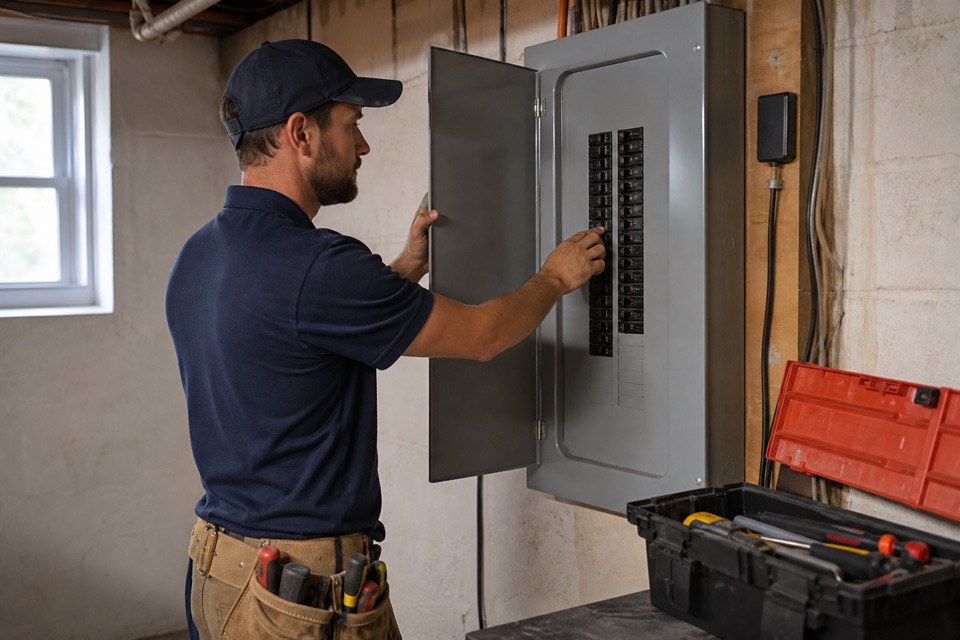
A continuous flashing red light, or erratic codes that do not match the standard manual, can sometimes indicate a bad ground, reversed polarity, or a failing breaker in the home's main electrical panel. Furnaces use a process called flame rectification to prove a flame exists, and this process requires a perfect electrical ground. If the ground wire is loose at the breaker box, the furnace motherboard will fail to read the flame sensor, triggering a lockout.
Common electrical issues that trigger furnace codes:
- Reversed Polarity: If the hot and neutral wires were swapped during a previous repair or installation, the motherboard's safety checks will fail.
- Poor Grounding: A loose ground wire at the panel or the furnace junction box prevents the flame sensor from completing its micro-amp circuit.
- Voltage Drops: A failing circuit breaker or overloaded electrical panel can cause voltage dips that force the motherboard to reboot or lock out.
This is where our dual expertise becomes invaluable. As a combined heating, cooling, and electrical company, our team at Allred Heating Cooling Electric can uniquely diagnose whether the lockout is a localized furnace failure or a broader electrical panel and wiring issue. Repeatedly replacing furnace parts when the actual issue lies in the home's wiring is a frustrating and ineffective cycle. A comprehensive diagnostic approach ensures the true root cause is resolved.
How to Safely Reset Your Furnace After a Hard Lockout
If your furnace is in a hard lockout, it will not attempt to heat your home again until the system is reset. The furnace initiates this lockout specifically to prevent dangerous situations, such as unburned gas accumulating in the combustion chamber. If you have observed the LED flash sequence and written it down, you can attempt a single, safe power cycle to see if the error was a temporary glitch.
Follow these steps to safely perform a single reset:
- Turn down the thermostat: Set your thermostat to "Off" or lower the temperature setting well below the current room temperature. This stops the thermostat from calling for heat during the reset.
- Cut the power: Locate the power switch next to the furnace (it usually looks like a standard light switch). Flip it to the "Off" position. If you cannot find this switch, you can turn off the dedicated furnace breaker in your main electrical panel.
- Wait five minutes: This waiting period is critical. It allows any residual electrical charge in the motherboard to dissipate, clearing the fault memory. It also provides time for any residual gas in the system to safely vent away.
- Restore the power: Flip the switch or breaker back to the "On" position.
- Call for heat: Go back to your thermostat and set it to "Heat," raising the temperature a few degrees above the room temperature.
Listen closely as the system starts up. If the system clicks but will not produce heat, or if it immediately returns to a blinking red light, the underlying issue remains. The sequence of operations in a gas furnace startup involves multiple safety checks, and failing any of them will trigger another lockout.
We recently had a customer experience unexpected furnace issues on a chilly Saturday morning in November. Expecting a long delay, they were relieved when our dispatcher provided telephone guidance to attempt a safe reset first. When the safe reset failed to clear the code, one of our technicians came out quickly to fix the underlying mechanical problem, getting the furnace up and running within an hour.
Crucial Safety Warning: Never attempt to bypass safety switches, tape down limit switches, or repeatedly reset the system over and over. If the furnace locks out a second time, it is doing so to protect your home from a serious hazard.
When to Stop Troubleshooting and Call a Professional
While observing the LED flash sequence and performing a single power cycle are safe tasks for a homeowner, there is a hard line where DIY observation must end and professional intervention begins. Any task that requires the removal of the furnace panel, handling of high-voltage wiring, or testing of gas components must be left strictly to a licensed professional.
Signs you need immediate expert help:
- Recurring lockouts: If you reset the furnace and it locks out again within a few hours or days, a component is actively failing.
- Unusual odors: A burning smell, the scent of melting plastic, or a sulfur/rotten egg smell (indicating a gas leak) requires you to turn off the system immediately and call for help.
- Continuous flashing lights: Uncounted, rapid flashing often points to electrical grounding issues that require a multimeter and electrical expertise to trace safely.
- Strange noises: Grinding, scraping, or loud booming sounds during ignition indicate mechanical failure or delayed gas ignition.
At Allred Heating Cooling Electric, we always tell our customers that catching these diagnostic codes early is the best way to protect your heating system. Scheduling professional seasonal maintenance and tune-ups allows our technicians to clean flame sensors, check limit switches, and clear pressure switch tubing before the heavy winter weather arrives. Proactive care prevents mid-winter breakdowns and ensures your furnace operates safely all season long.
Frequently Asked Questions About Furnace Motherboard Lights
Why is the red light blinking on my furnace?
It indicates the furnace's diagnostic system has detected a fault and shut down for safety. The system is communicating an error code through a specific sequence of flashes to help identify which internal component failed during the heating cycle.
How do I reset my furnace after a lockout?
Turn down the thermostat, switch off the furnace power at the wall switch or breaker for a full 5 minutes, then restore power. If it locks out again after this single reset attempt, professional service is required to fix the underlying issue.
Is a blinking red light on a furnace dangerous?
The light itself is a safety feature, not a danger. It means the system successfully detected a problem and shut down to prevent dangerous situations like gas buildup, electrical shorts, or severe overheating in the heat exchanger.
What does a continuous flashing red light on a furnace mean?
A continuous, uncounted flash often indicates reversed polarity or a grounding issue within your home's electrical system. This typically requires an electrical diagnosis to check the panel and wiring, rather than a standard HVAC part replacement.
Can a dirty filter cause a furnace to flash a red light?
Yes, severely restricted airflow from a dirty filter can cause the furnace to overheat rapidly. This triggers a limit switch fault code on the motherboard, forcing the system into a hard lockout to prevent fire hazards.
Get Expert Help for Your Furnace Lockout Today
A flashing red light shouldn't leave you shivering in the cold during a late fall chill. While understanding your furnace's diagnostic codes helps you communicate the problem, resolving a hard lockout safely requires professional expertise. Do not let a minor sensor issue or an electrical grounding fault turn into a major mid-winter emergency. Talk to our local experts at Allred Heating Cooling Electric who can safely diagnose the fault code, test your system's safety switches, and perform the necessary repairs. Schedule a professional inspection with our team today to restore safe, reliable, and consistent heating to your home.
Related Articles
Ready to Get Started?
Whether you need a repair, maintenance, or a new installation, our expert team is here to help.