AC Repair vs. Replace: An Objective Evaluation Framework for Homeowners
Trust Allred
Sudden Heatwaves and the AC Reliability Crisis
Summer in the Auburn/Kent area is fast approaching, and finding objective options comparisons for homeowners becomes critical when an aging cooling system faces severe weather shifts. As local HVAC professionals, we know firsthand that as the mild spring transitions into intense summer heat, your air conditioner is suddenly forced to run at maximum capacity. This sudden mechanical thermal load places immense stress on aging components, often leading to unexpected breakdowns right when you need relief the most. If you are evaluating the long-term reliability of your equipment against the appeal of immediate fixes, establishing a baseline with a comprehensive guide to HVAC services is the best place to start.
When a system fails during a heatwave, property owners face a difficult and immediate decision. Do you invest in replacing a broken part to get the cold air flowing again, or do you upgrade the entire unit to prevent future failures? Our team often sees that making this choice while your house is actively heating up leads to rushed, emotionally driven decisions. Instead, stepping back to use a math-based repair vs replace cost comparison removes the guesswork. By looking at concrete data rather than simply reacting to discomfort, you can evaluate the true long-term value of your cooling infrastructure.
The core evaluation factors:
- Immediate relief versus future risk: A quick patch solves today's heat, but leaves older, stressed components vulnerable to failure tomorrow.
- Total cost of ownership: Factoring in energy bills, future service calls, and the eventual inevitable replacement.
- System dependability: Ensuring your home remains safe and comfortable during the most extreme temperature spikes of the season.
This framework is designed to serve as a neutral evaluation tool. By applying logical criteria to your specific situation, you can navigate the crisis of a sudden breakdown with confidence and clarity.
Evaluating System Lifespan and the R-22 Refrigerant Phase-Out
Understanding the expected lifespan of your equipment is the first step in any accurate repair vs replace cost comparison. According to the U.S. Department of Energy, a central air conditioner typically lasts 15 to 20 years, provided it receives proper upkeep. In our daily service calls, we frequently find that if your system is approaching or has surpassed this benchmark, the mechanical wear on its internal components is likely severe. Bearings lose their lubrication, electrical contacts become pitted, and coils slowly degrade from years of condensation and pressure. At this stage, investing heavily in major component replacement often yields diminishing returns.
Beyond chronological age, regulatory changes have fundamentally altered the viability of maintaining older systems. The Environmental Protection Agency (EPA) has officially phased out the production and import of R-22 refrigerant due to its ozone-depleting properties. If your air conditioner was installed before 2010, there is a high probability it relies on this obsolete chemical.
Why the R-22 phase-out matters for your system:
- Scarcity of supplies: Because new R-22 cannot be manufactured, technicians must rely on reclaimed or stockpiled reserves to recharge leaking systems.
- Increasing service costs: The limited supply of R-22 has driven the cost of refrigerant recharges to prohibitive levels, making minor leak repairs disproportionately expensive.
- Part availability: Manufacturers have stopped producing replacement compressors and coils optimized for R-22, meaning finding compatible parts for an aging unit is becoming increasingly difficult.
When you combine an aging system with an obsolete refrigerant, the logical path forward shifts heavily away from patching. While keeping up with routine HVAC maintenance can extend the functional life of your equipment, our technicians agree there comes a point where servicing an R-22 unit is simply no longer practical.
Identifying Your System's True Age
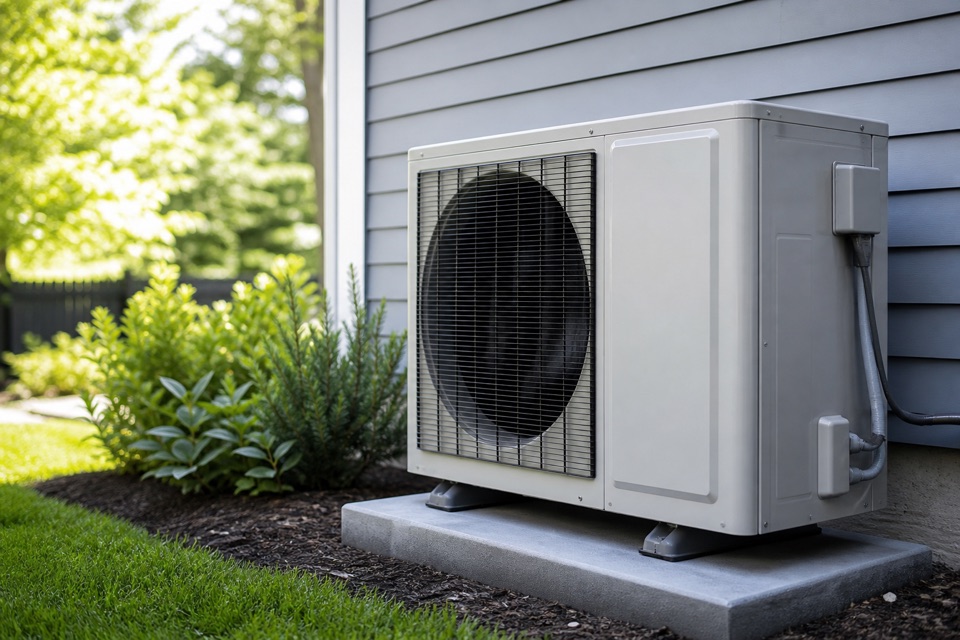
Chronological age is a primary factor, but operational wear also plays a significant role. If you inherited the system when you purchased the property, you can easily verify its exact age by checking the manufacturer's data plate. This metal or foil sticker is typically mounted on the side of the outdoor condenser cabinet. Look for a line labeled "MFD" (Manufactured Date). If the date is not explicitly listed, you can often decode the serial number by searching the manufacturer's brand guidelines online. We always advise customers to remember that a system running in a harsh environment without regular filter changes may suffer the wear of a 15-year-old unit in only a decade.
The 50% Rule: A Percentage-Based Repair vs Replace Cost Comparison
When faced with a significant service estimate, our team recommends relying on a universally recognized formula to help eliminate the stress of the decision. The "50% Rule" is an industry-standard framework that allows property owners to calculate a neutral repair vs replace cost comparison without getting bogged down in specific dollar amounts. The premise is straightforward: if the cost of the proposed repair, when multiplied by the age of the system, exceeds half the total value of a new installation, replacing the unit is statistically the better financial option.
How to apply the 50% Rule in practice:
- Step 1: Determine the repair ratio. Divide the estimated repair cost by the total cost of a new system to get a percentage.
- Step 2: Factor in the age. If a system is 10 years old and the repair ratio is 30%, you are approaching the threshold where replacement makes more mathematical sense.
- Step 3: Evaluate the threshold. If the repair exceeds 50% of the replacement value on its own, regardless of age, investing in the old unit is almost always a poor financial decision.
This percentage-based approach is highly effective because it accounts for the depreciating value of your existing equipment. Funneling half the cost of a new system into a condenser that may only survive another two years is a high-risk gamble. When applying this rule, it is also vital to consider the frequency of breakdowns. If you have required HVAC repair services multiple times over the past 24 months, those cumulative expenses should be factored into your overall system evaluation.
Multiple smaller repairs over a short timeframe strongly indicate that the system has entered a cascade failure phase. Fixing a capacitor today might simply clear the way for the blower motor to fail next week. By utilizing the 50% Rule, you shift your perspective from the immediate crisis to a comprehensive view of your home's mechanical infrastructure.

Analyzing Efficiency Loss and Long-Term Energy Consumption
The Problem: In our years of inspecting local cooling systems, we've found that as air conditioning units age, their mechanical efficiency naturally degrades. Dirt accumulates deep within the evaporator coils, compressor valves lose their tight seals, and blower motors draw more amperage to produce the same amount of airflow. This degradation means that a 15-year-old system is likely operating far below its original factory specifications. When efficiency drops, the system must run for longer cycles to achieve the temperature set on your thermostat, leading to a significant increase in monthly energy consumption.
The Cause: The core metric for cooling efficiency is the Seasonal Energy Efficiency Ratio (SEER). Older units typically operate at a SEER rating of 10 to 12. As internal components suffer wear and tear, that functional rating drops even lower. Continuous runtime due to lost efficiency puts unnecessary, compounding strain on the electrical and moving parts. The longer the compressor runs to satisfy the thermostat, the hotter its internal windings become, accelerating the eventual failure of the entire unit.
The Solution: Modern air conditioners are engineered to meet much stricter federal efficiency standards, often starting at 14 or 15 SEER and scaling upward. Upgrading to a newer, higher-SEER model can reduce your home's cooling energy consumption by 20% to 50% compared to an aging, degraded unit. When conducting a thorough repair vs replace cost comparison, this reduction in monthly operating costs must be factored into the equation. Over the lifespan of a new system, the cumulative energy savings can offset a significant portion of the initial installation investment, making the replacement option far more economically sound than continuously patching an inefficient energy hog.
How Pacific Northwest Temperature Spikes Stress Aging Compressors
Having serviced homes throughout the Pacific Northwest for years, our team understands the unique challenges our climate presents for residential cooling systems. Historically known for mild summers, the region has increasingly experienced sudden, intense heat spikes that push temperatures well into the 90s and beyond. When these unexpected heatwaves strike, HVAC systems that have sat idle or run on low capacity for months are suddenly demanded to operate at peak output for days on end. This drastic shift creates severe mechanical strain on compromised air conditioning systems.
The impact of extreme heat on aging components:
- Thermal overload: Compressors generate significant heat during operation. When outside temperatures soar, the system struggles to dissipate this heat, leading to thermal overload and sudden shutdowns.
- Continuous operation: An undersized or aging unit will run non-stop trying to overcome a 30-degree temperature differential, causing immense wear on the contactors and capacitors.
- Pressure spikes: High ambient heat causes refrigerant pressures to rise, testing the integrity of every braze joint and valve in an older R-22 system.
A patched-up, aging compressor is significantly more likely to fail under this continuous heavy load. Experiencing a total system breakdown during a severe heat event is more than just an inconvenience; it poses real safety and comfort risks, especially for vulnerable family members. When evaluating your options, system dependability must sometimes outweigh the appeal of a short-term fix. Ensuring your home can withstand the next major temperature spike is paramount, which is why consulting with experts for professional AC repair or replacement assessments before the heatwave hits is a critical preventative measure. A thorough repair vs replace cost comparison will clearly highlight the value of reliability during extreme weather.
Warranty Protection vs. The Cycle of Continuous Patching
One of the most overlooked elements in a repair vs replace cost comparison is the allocation of future risk. When you authorize an expensive repair on an older unit, you are assuming all the financial risk for whatever breaks next. Conversely, upgrading to a new system transfers that mechanical risk back to the manufacturer.
Typical manufacturer warranties on new installations provide comprehensive coverage for major internal components, often lasting up to 10 years when properly registered. This provides profound peace of mind. If the compressor fails or the evaporator coil develops a leak in year five, the manufacturer provides the replacement part. When you patch an out-of-warranty system, the new part (such as a blower motor) might come with a brief 90-day guarantee, but repairing that one component does absolutely nothing to reset the clock on the aging compressor or the rusting condenser coil.
| Evaluation Factor | Out-of-Warranty Patching | New System Installation |
|---|---|---|
| Component Coverage | Only the specific replaced part is covered (typically 30 to 90 days). | Comprehensive manufacturer warranty covers all internal parts (often up to 10 years). |
| Risk of Secondary Failure | High. Old components remain under stress and are likely to fail next. | Low. All components are factory-new and engineered to work together. |
| Efficiency & Operating Costs | System continues to operate at a degraded, low-SEER efficiency. | Immediate 20% to 50% reduction in cooling energy consumption. |
| Peace of Mind | Low. Homeowners often worry about the system surviving the next heatwave. | High. Protected by warranties and modern reliability standards. |
Breaking the cycle of continuous patching requires looking at the broader picture. Working with our trusted local team at Allred Heating Cooling Electric ensures that whether you ultimately choose to repair or replace, the work is done correctly, safely, and efficiently the first time. Having verified local experts handle your system assessment guarantees that your evaluation is based on accurate diagnostics rather than guesswork.
Your Neutral AC Evaluation Checklist
Synthesizing the data into an actionable format allows you to make a clear, objective choice regarding your home's cooling infrastructure. Our team advises using this neutral evaluation checklist to build your own repair vs replace cost comparison before authorizing any major work.
- System Age: Is your air conditioning unit approaching or past the 15-year mark? Systems in this age bracket are at the end of their intended lifecycle.
- Repair Frequency: Have there been multiple service calls or component failures in the past 24 months? A pattern of breakdowns indicates cascade failure.
- The 50% Rule: Does the current repair estimate, when factored with the system's age, exceed the logical threshold for reinvestment?
- Refrigerant Type: Does the system still rely on obsolete R-22 refrigerant? If so, any leak or compressor issue should strongly trigger a replacement consideration.
- Comfort Levels: Is the system struggling to maintain consistent temperatures during peak heat? Long runtimes and uneven cooling indicate severe efficiency loss.
If you answer "yes" to two or more of these criteria, the data strongly suggests that investing in a new, high-efficiency system will provide better long-term value than continuing to fund emergency patches.
Frequently Asked Questions About AC Longevity and Failure
Is it better to repair or replace an air conditioner?
The answer depends entirely on the age of the unit and the cost of the fix. If the system is under 10 years old and the repair is minor, fixing it is usually the right choice. However, if the system is over 15 years old, uses obsolete refrigerant, or requires a repair that triggers the 50% rule, replacement is the more financially sound option. A proper repair vs replace cost comparison will clearly highlight which path offers the best total value.
At what age should an AC unit be replaced?
Most central air conditioning systems are engineered to last between 15 and 20 years with regular maintenance. Once a unit crosses the 15-year threshold, it becomes highly susceptible to major component failures like seized compressors or leaking coils. Replacing the unit around this age often prevents the stress and discomfort of a sudden breakdown during peak summer heat.
When is an air conditioner not worth repairing?
An air conditioner is no longer worth repairing when the cost of the fix exceeds half the value of a new system, or when it requires obsolete R-22 refrigerant to function. Additionally, if the system has broken down multiple times in a single season, you are experiencing cascade failure. At that point, sinking more funds into the unit is a poor investment.
How do I know if my AC compressor is failing?
A failing compressor often presents clear warning signs before shutting down completely. You may notice loud grinding or clanking noises, the system tripping your electrical breaker repeatedly, or warm air blowing from your vents despite the unit running constantly. Because the compressor is the heart of the system, its failure usually prompts a full system replacement evaluation.
How does the phase-out of R-22 affect my older AC unit?
The EPA's phase-out of R-22 means the chemical is no longer legally produced or imported in the United States. If your older unit develops a leak, technicians must use limited, expensive stockpiled refrigerant to recharge it. This scarcity makes major repairs on R-22 systems economically impractical, reinforcing the need for a modern, environmentally friendly upgrade. For more details on system components and upkeep, reviewing a comprehensive HVAC system FAQ can provide additional clarity.
Make a Confident, Data-Backed Cooling Decision
Evaluating a struggling air conditioning system does not have to be an exercise in guesswork or frustration. By relying on the criteria of system age, efficiency loss, and repair cost thresholds, you establish a clear, logical path forward. Utilizing a math-based repair vs replace cost comparison framework removes the emotion from the process, ensuring your investment protects your home's comfort for the long haul. Before the next major temperature spike hits, take the time to seek a neutral, expert assessment from our team. With the right data in hand, you can make a confident, logic-based decision that prioritizes both your budget and your peace of mind.
Ready to Get Started?
Whether you need a repair, maintenance, or a new installation, our expert team is here to help.