What to Do When Your Carbon Monoxide Detector Sounds During Furnace Operation
Trust Allred
A CO alarm triggering during your first fall furnace start-up is a life-safety emergency. See the immediate evacuation steps you must take and why a cracked heat exchanger is the likely culprit.
Why Is My Carbon Monoxide Alarm Sounding Right After Turning on the Heat?
Are you wondering what to do when your carbon monoxide detector sounds during furnace operation, especially if you just turned the system on for the first chilly night of the season? Hearing a piercing siren the exact moment your heating system kicks on is a terrifying experience. When you are performing a September first-time furnace start-up, you expect warm air, not a life-safety emergency. However, if your carbon monoxide (CO) alarm triggers shortly after the thermostat calls for heat, your furnace is the prime suspect.
Carbon monoxide is an odorless, colorless, and tasteless gas. Because human senses cannot detect it, your electronic carbon monoxide detector is your home's only line of defense against this highly toxic byproduct of combustion. A full alarm during a heating cycle is not an HVAC malfunction you can ignore or troubleshoot later; it is an immediate emergency that requires decisive action to protect your household.
Immediate Emergency Action Steps: Do This Right Now
When your carbon monoxide detector goes off while the furnace is running, you do not have time to investigate the cause or search for the source of the problem. Your only priority is life safety. Follow these highly specific emergency protocols immediately.
1. Turn Off the Furnace at the Thermostat
The quick action: Immediately switch your thermostat from "Heat" to "Off."
By shutting down the furnace, you stop the active combustion process. If the furnace is the source of the leak, turning it off halts the production of fresh carbon monoxide and stops the blower motor from circulating the toxic gas through your ductwork and into your living spaces.
2. Open All Windows and Exterior Doors
The quick action: Throw open windows and doors on your way out to ventilate the home.
Carbon monoxide can build up rapidly in enclosed spaces. By opening doors and windows, you introduce fresh oxygen and allow the concentrated toxic gases to dilute and escape. Do not spend excessive time doing this—only open the windows that are directly in your path as you exit the building.
3. Evacuate the Home Completely
The quick action: Get every family member and pet outside into fresh air immediately.
Do not stay inside to gather belongings, and do not attempt to go into the basement or utility closet to look at the furnace. Carbon monoxide poisoning can cause sudden dizziness, confusion, and loss of consciousness. Evacuate everyone to a safe distance outside the home where the air is completely clear.
4. Call 911 or Your Local Gas Utility
The quick action: Dial emergency services only after you are safely outside.
First responders and utility companies have specialized, highly sensitive equipment that can measure the exact parts-per-million (PPM) of carbon monoxide in your home. They will enter the property wearing protective gear, locate the source of the leak, and physically shut off the gas supply to the appliance to render the home safe.

The Fatal Mistake: Assuming It's Just a False Alarm or Dead Battery
When an alarm interrupts a quiet evening, the natural human reaction is to rationalize the noise. Our team at Allred Heating Cooling Electric has responded to countless calls where homeowners initially tried to convince themselves that their detector was simply old, malfunctioning, or in need of new batteries—especially if no one in the house felt actively sick yet. This assumption is a fatal mistake.
Carbon monoxide poisoning is cumulative. The early physical symptoms are easily dismissed because they mimic common ailments. You might experience a mild, dull headache, sudden fatigue, slight dizziness, or a feeling of nausea. Because these symptoms are so subtle, waiting until you feel sick to take action often means you have already been exposed to dangerous levels of toxic gas.
It is crucial to understand the difference between a low-battery warning and a full emergency alarm. A low-battery indicator is typically a single, intermittent chirp that happens every 30 to 60 seconds. A full emergency alarm is a continuous, loud, aggressive beeping pattern (often four quick beeps followed by a pause). If you hear a full alarm pattern during a heating cycle, it is rarely a coincidence. You must treat it as a confirmed, active leak until first responders with specialized meters prove otherwise.
| Alarm Sound Pattern | Meaning | Required Action |
|---|---|---|
| Continuous loud beeping (e.g., 4 beeps, pause, 4 beeps) | Emergency: Carbon monoxide detected | Evacuate immediately and call 911. |
| Single chirp every 30-60 seconds | Low battery warning | Replace batteries as soon as possible. |
| Single chirp with flashing error light | Detector end-of-life / malfunction | Replace the entire detector unit. |
The Hidden Culprit: How Cracked Heat Exchangers Leak Carbon Monoxide
To understand why your furnace is suddenly producing carbon monoxide, you have to understand the mechanics of how your heating system generates warm air. The process relies on a critical component called the heat exchanger, which acts as the absolute barrier between toxic exhaust and the air you breathe.
The Role of the Heat Exchanger
When your furnace turns on, burners ignite natural gas, propane, or oil inside a sealed metal chamber. This combustion process generates intense heat, but it also creates toxic byproducts, including carbon monoxide. The metal walls of the heat exchanger get incredibly hot. Meanwhile, your furnace's blower motor pulls cold air from your home and blows it over the outside of this hot metal chamber. The air warms up and travels through your vents, while the toxic exhaust inside the chamber is safely vented out of your home through the flue pipe.
The Problem: Metal Fatigue and Cracks
Every time the furnace cycles on, the intense heat causes the metal of the heat exchanger to expand. When the cycle ends, the metal cools and contracts. Over years of operation, this constant expansion and contraction causes metal fatigue. Eventually, the stressed metal can develop hairline cracks or stress fractures.
The Dangerous Solution: Forced Air Leaks
When a crack forms in the heat exchanger, the barrier is compromised. Because the blower motor pushes air over the heat exchanger with significant force, it changes the pressure dynamics inside the system. This pressure can force the toxic carbon monoxide out of the combustion chamber, through the crack, and directly into the clean air stream. From there, the ductwork distributes the poisoned air into every room of your house. According to safety agencies, a cracked heat exchanger is one of the leading causes of residential CO leaks during the heating season.
Why Summer Dormancy Accelerates Furnace Metal Fatigue
You might wonder why these catastrophic failures so frequently reveal themselves in the early fall. The answer lies in what happens to your furnace during the long summer months when it sits completely dormant.
In our years of serving Auburn WA and the surrounding Pacific Northwest, our technicians have seen firsthand how our local climate plays a massive role in equipment lifespan. Heat exchangers spend the summer sitting in dark, often humid basements, crawlspaces, or utility closets. The damp climate increases ambient moisture, and because the furnace is not firing up to dry itself out, that moisture settles on the metal components.
The rust factor: Over the summer, this condensation causes surface rust to form on older metal heat exchangers. Rust eats away at the integrity of the steel, thinning the walls and creating weak points. Existing micro-fractures become deeper and more brittle.
The sudden shock: When you finally turn the system on for that first chilly September night, the sudden, extreme blast of heat hits that weakened, rusted metal. The thermal shock causes the compromised steel to snap, expanding those micro-fractures into full cracks. This is a pattern we see often: a system that seemingly worked fine at the end of last winter will suddenly trigger a carbon monoxide alarm on the very first day of the new heating season.
Why Professional Diagnosis After First Responder Clearance is Non-Negotiable
Once you evacuate and call emergency services, the fire department or your local gas utility will arrive to secure the situation. They will use their meters to confirm the presence of gas, ventilate the property, and shut off the gas supply to the furnace. However, their job ends at life safety. They will red-tag your furnace, meaning it is legally condemned from operation, but they will not repair the equipment.
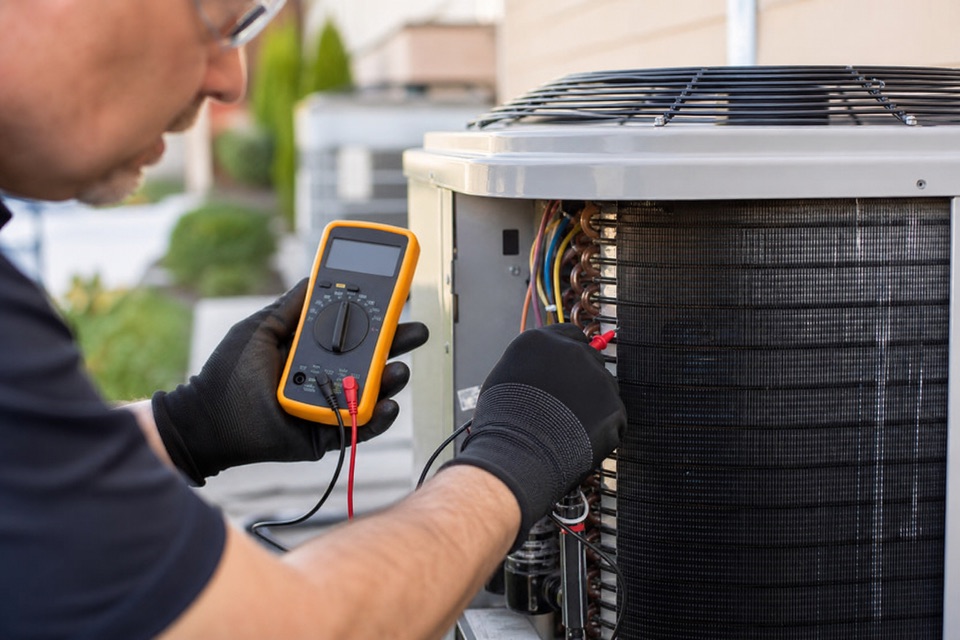
This is the moment where professional HVAC intervention becomes non-negotiable. Inspecting a heat exchanger is incredibly complex and dangerous. It cannot be done visually by a homeowner shining a flashlight into the cabinet. Our licensed technicians at Allred Heating Cooling Electric use specialized tools, such as digital combustion analyzers to measure exhaust gases and high-definition infrared inspection cameras to snake deep into the serpentine curves of the metal to locate microscopic fractures.
Attempting to DIY-repair a heat exchanger is against all building codes and is exceptionally dangerous. You cannot patch, weld, or tape a cracked heat exchanger; the intense heat and pressure will immediately destroy any temporary fix, putting your family right back in danger. Allred Heating Cooling Electric prioritizes rapid emergency response because we know that a red-tagged furnace leaves your family without heat. Our commitment to safety means we deploy quickly to provide a definitive, accurate diagnosis so you can make an informed decision about your home's heating.
The severity of this issue is not theoretical. Just last fall, our team responded to a local Auburn homeowner whose furnace stopped working entirely. A professional inspection by our crew revealed cracked heat exchangers that posed a severe carbon monoxide poisoning risk. By having our licensed technicians properly evaluate and ultimately replace the system, the household's health and safety were protected from further exposure.
Next Steps: Evaluating Your Furnace After a Critical Safety Failure
Once a professional technician confirms that your heat exchanger has failed, you are faced with a major decision. A cracked heat exchanger is a catastrophic failure. Because the component is the core of the furnace, replacing it is a highly labor-intensive process that requires dismantling the entire system.
Your next steps depend heavily on the age and overall condition of your heating system. In our experience, heat exchanger failures typically occur in systems that are older than 10 to 15 years, as it takes time for metal fatigue and summer corrosion to take their toll.
- Warranty Status: If your furnace is relatively new, the heat exchanger may still be under a manufacturer's warranty, which can cover the cost of the part (though labor is usually separate).
- Age of the System: If your unit is approaching the end of its expected lifespan, investing heavily in a major repair is often a poor financial choice. The blower motor, control board, or gas valve could fail next.
- Efficiency Gains: Modern furnaces are vastly more efficient and feature advanced safety sensors that older units lack. Upgrading often provides better comfort and peace of mind. Additionally, federal tax credits or local utility incentive programs may apply to qualifying high-efficiency installations. We always advise homeowners to verify current programs with their utility provider or a tax professional.
If you are standing at this crossroads with an older system, you will need to carefully weigh your options. For a deeper dive into making this decision, read our comprehensive guide on repairing a 15-year-old furnace versus upgrading to a safer, modern system.
Frequently Asked Questions About Furnace Carbon Monoxide Leaks
Why is my carbon monoxide detector going off when the heat is on?
The furnace is likely producing combustion gases that are escaping into the home's air supply instead of venting outside. When your heating system operates normally, all toxic exhaust is pushed safely out of the flue pipe. If the alarm sounds only during a heating cycle, it strongly points to a mechanical failure within the furnace, most commonly a cracked heat exchanger or a severely blocked exhaust flue. Both issues require immediate professional attention.
Can a furnace cause a carbon monoxide leak?
Yes, any appliance that burns fuel (natural gas, propane, or oil) produces carbon monoxide as a byproduct of combustion. Under normal, safe conditions, a furnace contains this gas within the heat exchanger and vents it outdoors. However, if the system's internal barriers fail, or if the venting pipe becomes disconnected or blocked by debris, that carbon monoxide can rapidly leak into your living space.
Who to call when a carbon monoxide detector goes off?
Always call 911 or your local gas utility first from outside the home to ensure the environment is safe. First responders have the equipment to measure gas levels and will shut off the fuel supply to neutralize the immediate danger. Once the home is cleared by emergency personnel and deemed safe to enter, we recommend calling a licensed HVAC professional to diagnose the broken equipment and perform the necessary repairs.
Is it a false alarm if my CO detector goes off?
Never assume it is a false alarm. While detectors can occasionally malfunction or issue a low-battery chirp, a continuous, loud alarm during furnace operation is a massive red flag. Carbon monoxide is completely invisible and odorless, meaning you cannot verify the air is safe yourself. Always treat it as a real, life-threatening emergency until professionals with specialized meters confirm otherwise.
What are the early symptoms of a furnace carbon monoxide leak?
Early physical symptoms include dull headaches, weakness, dizziness, nausea, or a sense of confusion that improves when you leave the house. Because these mimic the flu, they are easily ignored. Environmental signs in your home might include excess condensation on the inside of your windows, soot building up around the furnace cabinet, or a burner flame that burns yellow or orange instead of a crisp, clean blue.
Restore Safe, Reliable Heat to Your Home
When it comes to heating your home, safety must always come first. A carbon monoxide alarm is a terrifying wake-up call, but it is also a vital warning system that did its job by protecting your family from an invisible threat. Once the immediate emergency has passed and first responders have secured your home, the only way to restore true peace of mind is through a plain-English diagnosis from a licensed professional. Do not leave your family's safety to chance—contact our experts at Allred Heating Cooling Electric today to inspect your dormant system or safely address a recent shut-down.
Related Articles
Ready to Get Started?
Whether you need a repair, maintenance, or a new installation, our expert team is here to help.